Total Pageviews

Wednesday, February 8, 2023

Current market conditions are a recipe for disaster

 Bulls have been very resilient with the fuel on fire provided by JPow. It seems all the sky is clear from now on and a new bull market has been born.

I'm not so sure although admittedly I may have to adjust the timeline how the market trend may evolve for the year. I have been quite confident that we could see a new low during the first half of the year. If that new low triggers a widespread panic and towel throwing, we may see the ultimate bottom, from which a new bull market may start for the later part of the year. But I'm not so sure about it now. Instead, a real possibility may become that we may see some shallow correction in the days ahead and then we may even start to see a fairly strong rally, which could carry SPX towards 4300-4400 during the first half of the year. Only after that, we may start to see the major leg down for the ultimate bear market bottom later of the year. It is difficult to say right now which scenario will play out and it is very important to see how SPX will behave during the current correction. It seems the 3950ish level is very critical to see if it can hold. If yes and rally from there to over above 4200, then we will soon see 4300/4400. Otherwise, a very bearish bottom finding event will start soon.
 
Regardless of what is going on, I'm still happily 浑水摸鱼

Here is what I shared with my DW Family on Monday.


You may also hear some very bearish talk from some gurus here:

Earnings season is about 75% over… and honestly, it’s been terrible. I break down some numbers that show why the headlines about “beating earnings” aren’t nearly as positive as they sound… why the next few quarters are going to be ugly… and why Wall Street’s expectations are ridiculously high. Put simply, the current market conditions are a recipe for disaster.


simply, the current market conditions are a recipe for disaster.

Tuesday, February 7, 2023

He’s Scared To Death


Biden Downplays Document Scandal. Secretly, He's Scared To Death

The initial shock of the Biden classified documents scandal has worn off, but the scandal itself is still going strong. It began with the "discovery" of classified documents illegally removed from government offices by Biden before he left office as vice president in January 2017. These documents were discovered in the Penn Biden Center (a DC think tank sponsored by the University of Pennsylvania) on November 2, 2022. However, this discovery was covered up until after the mid-term elections in order not to hurt Democrat chances. In fact, the Democrats strengthened their control in the Senate and almost held onto control of the House of Representatives. The existence of the documents was announced in early January once the new Democrats were safely sworn in Yet, the entire episode was a fraud because Biden had the documents for at least six years, from January 2017 to January 2023. This wasn't a two-month cover-up; it was a six-year cover-up. Of course, four more troves of documents were then "discovered" in Biden's garage, his personal library, and elsewhere in his house. The documents were handled by lawyers, some of whom did not have the security clearances needed even to look at the documents. The FBI was only tangentially involved in contrast to Donald Trump's classified documents episode when a heavily armed FBI swat team broke down the doors of Trump's Mar-a-Lago estate in Palm Beach and then rifled through Melania Trump's underwear drawers. Despite these cover-ups, events have taken a more serious turn for Biden. As reported in this article a special counsel has been appointed by the Department of Justice (DOJ) to investigate Biden. Given the corruption in the DOJ, the investigation could just be part of the cover-up. But the history of special counsels is that they eventually come back with serious charges. This case is not just about mishandling classified documents. It's also about linkages between Joe Biden and Hunter Biden in terms of influence peddling, money laundering, tax evasion, and more. People in the White House are starting to throw each other under the bus as in the case of Biden's assistant Kathy Chung who is being blamed for wrongfully moving the documents from the White House. This is how Watergate played out in 1972 – 1974, with small leaks turning into big leaks and finally turning into criminal charges and the resignation of a president. This scandal is not going away. It will follow Biden on the campaign trail every day assuming he decides to run for reelection. It's just one more layer of uncertainty for investors to navigate.

Jim Richards

Monday, February 6, 2023

While the market is temporarily losing its mind, many people have not!

Washington Post-ABC News poll released ahead of the speech suggests Americans are less enamored with the White House's overall efforts to improve their lives. The poll found 62% of Americans believing that Biden had accomplished "not very much" or "little or nothing" during his presidency so far, while 36% thought he had accomplished "a great deal" or "a good amount." On many of Biden's signature initiatives — from improving the country's infrastructure to making electric vehicles more affordable to creating jobs — majorities of Americans said they did not believe he had made progress. The dynamic arguably raises the stakes of Biden's prime time speech on Tuesday.

Washington Post-ABC Poll: Americans not feeling impact of Biden agenda, poll finds

Sunday, February 5, 2023

Underestimating overestimation

I know it is quite a confusing title but basically I mean there is a widespread overestimation for company earnings by Wall Street and the market is still underestimating the extent of such overestimation. So we will see more surprises moving forward that will trigger more downward drifts for the market. While I do see the budding of a newly emerging bull market that may come some time this year, I think it is way too early to think the bear market is over. I wish we will see another strong leg down in the weeks ahead with positive long term divergence to show up. This will tell us more decisively a bottom has been hit. I cannot say confidently that's the case now!

Big Tech Stocks Roll Out Their Earnings

After riding a high in investor's portfolios for many years, the FAANG stocks – Meta Platforms, Inc. (META), Amazon.com, Inc. (AMZN), Apple, Inc. (AAPL), Netflix, Inc. (NFLX) and Alphabet, Inc. (GOOG) – took a tumble in 2022. And, unfortunately, some stumbled again in the wake of their latest earnings announcements this week. Let's see how they did.

Meta Platforms, Inc. (META) – Announced Wednesday, February 1

Meta's fourth-quarter revenue declined 4% year-over-year to $32.2 billion but did beat Wall Street consensus estimates for revenue of $31.5 billion. Meanwhile, earnings per share fell 52% year-over-year to $1.76 per share, down from earnings of $3.67 per share in the same quarter of last year. On a more positive note, the monthly active Facebook users rose 2% to 2.96 billion.

During the earnings call, CEO Mark Zuckerberg took the time to address the difficulties of the past year, such as the massive layoffs in November. He emphasized his new management theme for 2023, the "year of efficiency," while focusing on what the company can do now to improve productivity, speed and cost structure. He stated:

2022 was a challenging year, but I think we ended it having made good progress on our main priorities and setting ourselves up to deliver better results this year as long as we keep pushing on efficiency. I said last quarter that I thought our product trends look better than most of the commentary out there suggest. I think that's even more the case now.

Looking to the first quarter of 2023, Meta Platforms anticipates revenue between $26 billion and $28.5 billion. Analysts were calling for revenue of $27.1 billion. The company also expects expenses to be between $89 billion and $95 billion, due to "slower anticipated growth in payroll expenses and cost of revenue." Earnings per share are forecast to come in at $2.82, down from earnings per share of $3.53 a year ago. Company management also revealed that it would increase its stock buyback plan by $40 billion.

META shares surged 18% on Thursday following its earnings announcement.

    Amazon.com, Inc. (AMZN) – Announced Thursday, February 2

    Amazon rounded out its fiscal year 2022 with a mixed fourth quarter. The company reported adjusted earnings of $0.03 per share, which came in below analysts' estimates for earnings of $0.15 per share. Revenue rose 7.9% year-over-year to $149.2 billion, well above analysts' projections for revenue of $145.37 billion. This compares to earnings of $1.39 per share and revenue of $137.4 billion in the same quarter of last year. Amazon Web Services (AWS) revenue increased 20% year-over-year to $21.3 billion, just shy of analysts' estimates for $21.76 billion.

    Total sales for fiscal year 2022 came in at $514 billion, up 9% compared to $469.8 billion in 2021. For full-year 2023, revenue is expected to jump to $556.57 billion. For the first quarter of 2023, Amazon anticipates that revenue will rise between 4% and 8% to $121 billion and $126 billion, with growth driven by Amazon's need to make customers' lives better and easier every day. Earnings per share are forecast to come in at $1.58, down from earnings per share of $3.24 a year ago.

    CEO Andy Jassy said in a statement that "in the short term, we face an uncertain economy, but we remain quite optimistic about the long-term opportunities for Amazon."

    AMZN shares fell more than 6% on Friday in the wake of its earnings results.

    Apple, Inc. (AAPL) – Announced Thursday, February 2

    Apple's earnings results for its first quarter in fiscal year 2023 came in at $1.88 per share, which was 3.1% below analysts' estimates for earnings of $1.94 per share. Quarterly revenue of $117.2 billion was down 5% year-over-year and missed analysts' expectations of $121.2 billion by 3.3%.

    iPhone sales declined to $65.8 billion and missed Wall Street's estimates of $68.3 billion. Meanwhile, iPad revenue came in at $9.4 billion, beating estimates of $7.7 billion despite ongoing supply chain constraints.

    Also important to note: Apple's revenue for its Services business, which includes music and video subscriptions and sales from its App Store, hit an all-time high, coming in at a record $20.8 billion and above analysts' expectations for $20.4 billion. For its December quarter, paid subscriptions were 935 million.

    CEO Tim Cook stated, "As we all continue to navigate a challenging environment, we are proud to have our best lineup of products and services ever, and as always, we remain focused on the long term and are leading with our values in everything we do."

    Apple shares fell 3% Friday morning, though they rebounded later in the afternoon.

    Alphabet, Inc. (GOOG) – Announced Thursday, February 2

    Alphabet, Inc. disappointed Wall Street on Thursday evening with its fourth-quarter earnings and sales. The company reported earnings of $1.05 per share and sales of $76.05 billion. Analysts were calling for earnings of $1.18 per share and $76.53 billion.

    Full-year 2022 earnings of $4.56 per share were down from $5.61 per share in full-year 2021. Full-year 2022 revenue increased 10% to $282.8 billion, up from full-year 2021 revenue of $257.6 billion.

    Digging a little deeper into the report… Alphabet noted a nearly 8% decrease in its YouTube advertising revenue. Google Cloud sales jumped 32% to $7.3 billion in the fourth quarter.

    CEO Sundar Pichai stated, "There's great momentum in Cloud, YouTube subscriptions, and our Pixel devices. We're on an important journey to re-engineer our cost structure in a durable way and to build financially sustainable, vibrant, growing businesses across Alphabet."

    GOOG shares slipped more than 3% on the heels of its weak earnings report.

    Netflix, Inc. (NFLX) – Announced Thursday, January 19

      A couple of weeks ago we took a deep dive into Netflix's fourth-quarter earnings. As you may recall, Netflix reported earnings of $0.12 per share, down a whopping 91% from earnings of $1.33 per share in the same quarter last year. Analysts were calling for earnings of $0.45 per share, so Netflix missed estimates by 73.3%. Revenue of $7.85 billion was up slightly from $7.71 billion a year ago. This was in line with analysts' expectations.

      In a huge surprise, Netflix added 7.66 million paid subscribers in the fourth quarter – topping the company's own (and final) forecast of 4.5 million.

      Looking to the first quarter of 2023, Netflix anticipates that revenue will rise 3.9% to $8.17 billion, with growth driven by more paid memberships and more money per paid membership. Earnings per share are forecast to come in at $2.82, down from earnings per share of $3.53 a year ago.

      The stock jumped 7.8% on Friday on the surprising new subscriber numbers.

      A Mixed Earnings Bag

      As we can see, the big tech's earnings were a mixed bag. While some beat analysts' expectations, the reality is their fundamentals remain weak, as evidenced by the continued decline in earnings.

      Based on the post-earnings stock moves, it's clear fundamentals still matter, which is why it's important to focus on stocks with strong fundamentals, i.e., companies that are consistently growing their sales and earnings and posting positive forward-looking guidance.

      by Louis Navellier

      Saturday, February 4, 2023

      Fwd: What 2009 Reveals About the Current Market


      What 2009 Reveals About the Current Market

      By Eric Shamilov

      Yesterday's parabolic rally – in reaction to Fed Chair Jay Powell's comments – felt like it had some authority to it…

      It felt definitive… like a knockout blow to the thought that we're still in a bear market.

      After a January to remember – with the S&P 500 rising 6.2% (which placed it in the top 10 best Januaries since 1950) – many were looking for "calmer" heads to prevail into the Fed meeting on Wednesday… the same way it did almost every time last year.

      Last year, every rally was cut short after one of three economic releases: a CPI report, a jobs report, or an FOMC rate decision.

      A dovish narrative would build in the market… Stocks would rise and then ultimately collapse.

      But not this time…

      Not only did the Invesco QQQ Trust Series 1 (QQQ) rise after Powell's press conference… we also saw an additional 18% move in the futures market after Meta Platforms' (META) earnings report.

      But even before this recent melt-up, investors have been entertaining phrases like "This feels like March 2009" and "runaway momentum."

      During that time, sentiment was as low as it could get, coming off a dangerous credit crisis that threatened to stop the global economy. Yet the bottom was in, and the market just kept rising…

      Runaway momentum.

      Momentum is behavioral, which is why the creator of the efficient market hypothesis (Nobel Prize winner Eugene Fama) called it the "biggest embarrassment to the theory" of efficient markets.

      It's hard to fight and it just "runs away." And recently, momentum has been flexing.

      Everyone loves looking at moving averages (MAs) to gauge the market. It's the most accessible form of analysis out there.

      The S&P 500 and the Nasdaq-100 have broken out of their 200-day MAs and haven't been willing to break back below them like they did last year. That's bullish.

      Another technical sign that should give bears some pause is that the S&P 500's 50-day MA is on the cusp of crossing the 200-day MA. That never happened during the prior two prolonged bear markets in 2000-2003 and 2007-2009.

      On its own, that's bullish. I've even heard investors discuss this as a once-in-a-generation buying opportunity.

      But there's one stark difference between then and now…

      Those were not periods where inflation has forced the Fed to raise rates… potentially into a recession.

      But if you look back at the 1970s – the last time the U.S. economy had to fight inflation to the extent it does now – the 50-day MA traded above the 200-day MA several times before collapsing almost 50% between 1973 and 1974….

      Momentum works until it doesn't.


      What Was So Surprising About the FOMC Rate Decision?

      But despite this endless "point-counterpoint" argument about technical levels in the market… macro sentiment has been very negative. Price action has made being short the market a very painful exercise in abstaining from the view of the majority.

      It's a concern the famed investor (and unfairly labeled permabear) Robert Grantham expressed in his latest piece.

      He laid out his bear case for the market but had one concern… That he's no longer the only one bearish.

      And his fear is absolutely justified… As Mark Twain famously said, "Whenever you find yourself on the side of the majority, it is time to pause and reflect."

      So reflect on this… What exactly are we trading on? Is it a Fed pivot? Is it whether we're even going to have a recession?

      If we're trading a Fed pivot, then it first needs to be defined. If we're talking about slowing down the pace of rate hikes, then the Fed's latest action of raising by 25 basis points (bps) when they were previously raised by 75 and 50 should have no bearing on the market…

      Fed Fund swaps – an over-the-counter instrument that bets on what the Fed Funds rate will be – have been pricing in a 25 bps rate for yesterday's decision since October

      And, they accurately priced in the amount and pace of all of last year's interest rate moves as well.

      Right now, the June Fed Fund swaps are pricing in one more 25-bps rate hike… and have been doing so for months now.

      Nothing new there. The market has been well aware of what the Fed will do, and they have actually been on the same page.

      So, when I saw a wide-eyed pundit on Bloomberg TV express how a 25-bps rate hike on Wednesday was a statement move by the Fed when it could have raised by 50 bps… I was surprised by how talking heads can talk.

      However, if we define a Fed pivot as the Fed actually cutting rates, then it starts to get more interesting. Because right now, that's where the Fed swaps market and the Fed are diverging in their view.

      Fed swaps for December are pricing in the Fed Funds rate to be at 4.373% after December's rate decision. June swaps are at 4.885%…

      That means the market sees the Fed cutting rates by 50 bps in the second half of 2023.

      That kind of scenario can mean either inflation will get so low by the end of the year that the Fed will declare victory and cut rates… or it could be forced into cutting due to deteriorating financial conditions.

      And here's a paraphrase from Powell yesterday regarding the chance of a rate cut this year: "If the economy performs broadly in line with my expectations, it will not be appropriate to cut rates this year, to loosen policy this year."

      Meaning the only way he will cut is if there's a recession. And that is what I believe is being priced in.

      We're Still in a Downtrend

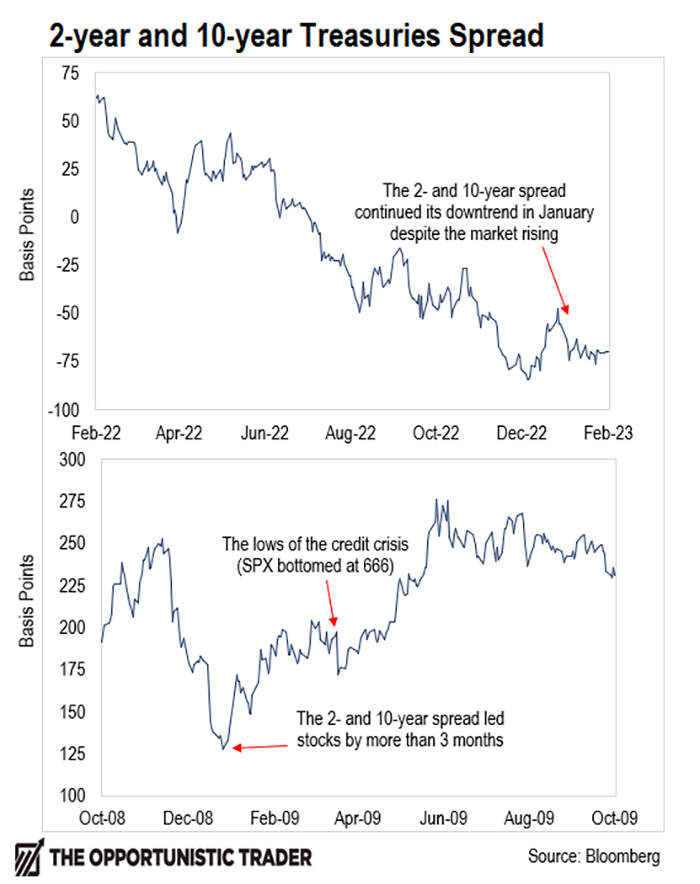
      Even during this stock market run, the yield curve – represented by the spread between the 2- and 10-year Treasury yield – has gotten more inverted since the start of the year, not less.

      Since many people are comparing now to March 2009, let's look at how the yield curve behaved then versus now…

      In March 2009, the spread bottomed three months before the low in stocks and then took off in April along with stocks. It's a leading indicator with a forward lag.

      Here's a look at both…
      Image

      And here's a chart of the ratio spread between the tech-heavy Nasdaq 100 (QQQ) and the more value-oriented S&P 500 (SPY).

      Image

      Despite huge up-moves in big-cap tech stocks like META and Tesla (TSLA) the last few weeks, this spread is still in a deep downtrend. That underscores that this bear market is still in a deep downtrend too.

      So, will 2023 be studied in future financial textbooks as a lesson of over-anticipating recession?

      Powell may have accurately answered that yesterday when he said, "The full effects of our rapid tightening so far are yet to be felt."