Total Pageviews

Thursday, July 2, 2020

Trigger to the March panic

The market has been really doing a great job to fight back in the past week. As I have explained in the last week's blog, "Right now, S&P is right above its 50 and 200 DMA (two pinned together), which should be a strong support. So likely it will try to bounce back from that level around 2975ish. How high will it rebound? Likely towards 3100 to 3150 area if a strong bounce."  Well, today's strong opening has just done that: it pushed the index above 3150, but just for a few hours. By end of the day, it closed well below 3150. So far, I have no reason to stay away from my belief: "But don't be fooled by even the seemingly strong bounce as its next leg down could be more powerful and severe. Watch its 50/200 DMA carefully! If they cannot be held and pierced through, it will become ugly very quickly!!" 

Let's me share with you another guru's technical view on the current status of the market that was posted this week. 

Per Market Watch

No doubt, stocks will be watching, which brings us to our call of the day, which discusses what could drive some big highs and lows for the S&P 500 SPX, +0.50% in weeks to come.

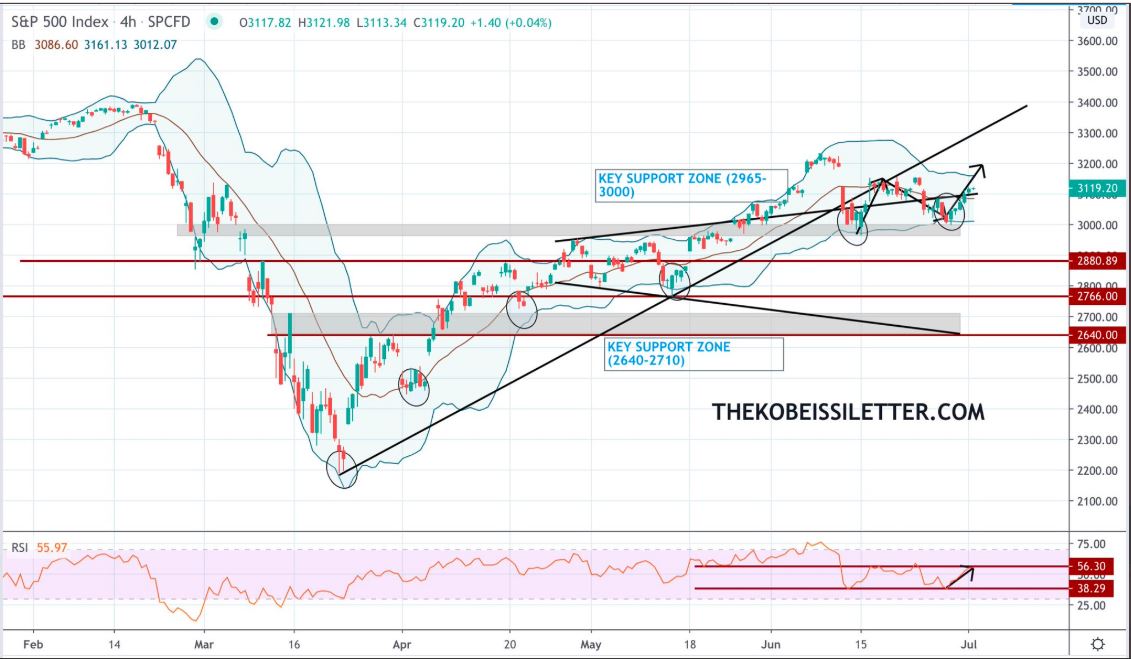
"As we look ahead, the biggest risk to markets is the return of panic, as we saw into the March 23 bottom where money was simply trying to get out. The only way panic at that magnitude returns is if the % positive number of cases continues to trend higher off the lows, which is very possible into the fall," writes Adam Kobeissi, founder and editor in chief of the Kobeissi Letter, an investment newsletter.

Kobeissi said that percentage of U.S. cases is currently hovering at 6%, from a low of 4.5%, according to Johns Hopkins University. If that figure starts inching higher, he expects the S&P will start to pull back. Note, U.S. cases topped 50,000 for the first time on Wednesday.

Over the short-to-medium term, he said the path of least resistance for stocks appears to be higher, with the technical picture suggesting a move to 3,150, which marks the high from June 15 to June 23, and a break above that would send the index to 3,275.

But from there, the index could pull back to a low of around 3,000 that was seen this week, partly due to simmering COVID-19 concerns. "It is important to note that 'higher lows' have formed SIX times since March 23, and the 2965-3000 support range marks the last two 'higher lows.' A break below 2,965 opens for significant downside, and we would expect to see 2,730 within a few trading sessions," Kobeissi said.

Sunday, June 28, 2020

Where Does It End?

Where Does It End?
A modest proposal to achieve a "historically correct" America

By Kerry D. Moynihan

There is a difference between right and wrong. It is important to know the difference between right and wrong. And without a doubt, enslaving people is wrong. We should not celebrate that wrong.

And yet, how far can we go in denigrating historical wrongs before we enter the Orwellian world of denying history's existence?

As George Orwell wrote in 1984...

If all others accepted the lie which the Party imposed – if all records told the same tale – then the lie passed into history and became truth. 'Who controls the past' ran the Party slogan, 'controls the future: who controls the present controls the past.'

And as the philosopher George Santayana said, "Those who do not learn history are doomed to repeat it."

A lot of work will have to be done if we decide to eliminate all celebrations of wrong and all memorials to wrongdoers.

So, I propose a thought experiment: If we need to make some changes, then, to be perfectly logical, we need to make all changes.

At the beginning of our nation (though not at the beginning of enslavement) there is George Washington. He held 317 people in bondage.

One American state, 31 counties, 55 cities, towns, and villages, 241 townships, and six major geological features are named after George Washington, as are 12 colleges and universities, nine important public parks, four of the nation's longest bridges, and innumerable avenues, boulevards, streets, roads, and highways.

What shall we rename them?

Ideally, they all should be named after oppressed persons. However, due to the oppression of persons because of their race – and also because of their gender, ethnicity, and sexual orientation – the names of most of the oppressed are lost to us. And the names of some of the oppressed – Carrie Nation, for example – could prove divisive among millennials who object to having their craft beer smashed with a hatchet.

In a gesture to neutrality and fairness, we could start the "Washington" renaming with the first 358-plus words in the dictionary... "A City," "Aardvarkville," "Abackburg," "Abacustown," and so on.

But dictionaries are a social construct of Western civilization's dead white males (such as Noah Webster, who's dead). So maybe an alphabetical approach won't do.

Perhaps we can use a random selection of tattoos from today's young people who are so vigilantly opposed to historical wrongs. For instance, Washington Pass, in the North Cascades mountains of Washington State, could be renamed "This Too Will" Pass, in "Follow Your Dreams" State.

Of course, you could wind up being someplace that didn't have a name at all... a place where you'd need to scroll through Google Maps looking for a hummingbird on someone's butt, instead.

And George Washington is only one small part of the larger problem. Eleven other American presidents, including some of those rated best by historians, owned slaves. Consider:

Thomas Jefferson, James Madison, James Monroe, Andrew Jackson, Martin Van Buren, William Henry Harrison, John Tyler, James K. Polk, Zachary Taylor, Andrew Johnson, and, of all people, Ulysses S. Grant.

Grant owned only one slave, William Jones, and freed him after one year. Despite Grant's desperate need for money at the time, he did not sell Jones. But, still...

Even wise and kindly Benjamin Franklin bought and sold people. Yes, he freed his slaves and he became president of America's first abolitionist society. But, still...

So here is a to-do list (with many, many, many more chores to be added to it):

1. Remove from public sight all references to anyone who ever owned slaves or at any time supported, explicitly or implicitly, the institution of slavery.

The movie The Bridges of Madison County is an easy fix, re-titled Worst Piece of Dreck in Which Meryl Streep and Clint Eastwood Ever Appeared.

But should the name of the lead characters in The Jeffersons disqualify the brilliant comedic work of African-American actors Sherman Hemsley and Isabel Sanford from being shown in reruns?

The capitals of Madison, Wisconsin and Montpelier, Vermont (named after Madison's Montpelier plantation) will need new monikers. I picture a (organic, GMO-free) butter-churning contest to decide which one gets the coveted name of "Cheesehead City." Bet on the muscular Green Bay fans. Montpelier will likely get "Maple Syrup Town."

New York's Madison Avenue will also have to be rechristened. I suggest "Avenue Clogged With Commuter Buses to Westchester." It's unwieldy, but it will remove the offending wig-wearer's name and lend the illusion that beleaguered Mayor Bill de Blasio cares about the largely forgotten, mostly Republican borough.

"The Monroe Doctrine," I suppose, will henceforth go by something on the order of "Doctrine of Yankee Imperialist Interference in the Sovereign Affairs of Latin American Nations, No Matter How Insane Those Sovereign Affairs Get."

John Jay was a Founding Father (a patriarchal and Eurocentric term that needs to be replaced with "Crypto-Colonialist Person Once Considered Significant") and the first Chief (a title insulting to Native Americans) Justice of the United States. So, the John Jay College of Criminal Justice will be renamed for all the people who have been wrongly convicted of crimes, starting with those unfairly arrested using prejudicial "stop and frisk" tactics. It will be a very long name for a college, but America has a very long history of Criminal Injustice.

2. Repurpose public spaces that memorialize ideas and actions that are wrong.

Mount Vernon, Monticello, Montpelier, and the University of Virginia's Jefferson-designed Rotunda and Lawn could be made into "safe spaces" for permanent "antifa" demonstrations. Republicans, Libertarians, and old-fashioned "free speech" liberal Democrats would be forbidden to venture within 10 miles.

Half of Mount Rushmore will be blasted away. Or all of it. Lincoln, early in his political career, made comments that were racist. And Teddy Roosevelt's actions in the Spanish-American War were clearly imperialistic. Maybe the cliff face can be ground smooth, made perfectly vertical, and turned into a climbing wall where people can learn the futility, frustration, and pain of the "American Dream" of "trying to get to the top" by falling off.

The Washington Monument and the Jefferson and Lincoln Memorials are ideal sites for low-incoming housing in a city where capitalist exploitation has made housing prices unaffordable to the homeless. Until the housing is built, these places can serve as squats for activist collectives.

3. Edit the Declaration of Independence to remove the signatures of the 41 (out of 56) signers who owned slaves.

Perhaps their names can be replaced with historically Black names, although this too presents difficulties. According to the 2010 census, some of the most common surnames of respondents who self-identified as Black were Washington, Jefferson, Jackson, and Wilson. (Woodrow Wilson was a notorious racist.)

Or we can replace the 41 slave-owner signatures with the signatures of important historic figures who would have signed but were prevented from doing so by the cultural inequalities of 1776. For an example, I'd name Dolley Madison – who was not only a woman but also a victim of the 18th century's dire lack of children's rights, being only eight at the time – but she also owned slaves later in life.

4. Rebrand any commercial enterprise that contains an offensive name, even if it is unrelated to the offending figure or spelled differently.

Lee Jeans and Lea & Perrins Worcestershire Sauce will become W. E. B. Du Bois Jeans and Sacagawea & Perrins Worcestershire Sauce.

And Robert Lee, the Asian-American ESPN broadcaster who – after the white supremacist riots in Charlottesville – was pulled from announcing the UVA/William and Mary football game because of his name...

That guy shall henceforth use the Chinese characters for he-who-must-not-be-named – R_____ E. L__.

"George Washington" will be removed from 32 parks, schools, and monuments dedicated to George Washington Carver, to avoid confusing him with the slave owner.

Ditto for Booker T. Washington. But Booker T. himself was somewhat soft on Jim Crow segregation, so we'll have to get rid of his first name and middle initial as well. All recordings by the seminal R&B/funk instrumental group Booker T. & the M.G.'s will be credited to the band, "And the M.G.'s."

5. Withdraw from circulation all currency and coins featuring offending figures.

No expense will be spared. The 2017 U.S. Treasury budget for replacing worn-out currency (notes only) is $726 million. By my estimation, the cost to replace all currency and coins defaced (as it were) with portraits of Washington, Jefferson, Lincoln, Hamilton (his family owned slaves), Jackson, Grant, Franklin, et al, will be at least $3 billion.

Because of this high cost and the already dubious value of money issued by the U.S. Treasury, I propose that the pictures on the new U.S. coins and currencies be of endangered species, particularly, the less intelligent and commercially valuable... the Alabama cavefish on the $1 bill and the American burying beetle on the $100 bill, to start.

But cost should not be our main consideration – the government will pay for it.

And the vast amount of money, time, and effort dedicated to achieving the goal of a "historically correct" nation will effectively eliminate unemployment, drive our economy, and increase our tax base.

It could be the biggest economic boon since Obama's "shovel ready" infrastructure stimulus projects. Hundreds of thousands of people will be gainfully employed tearing down street signs, demolishing statues, shredding currency, and the like.

After all, since we're denying history, let's deny economics, too...

If we use economic assumptions that are "right" (Keynesian government spending) rather than "wrong" (Reaganomic government thrift), the way we're using historical assumptions that are "right" (full of nice thoughts about social justice) rather than "wrong" (history as historians recount it)...

Why, we could...

We could "make America great again!"
Saturday, June 27, 2020

The market looks shaky

After reviewing the S&P chart more closely again, it seems to me that the market looks quite shaky as of now. Clearly S&P has broken down from its uptrend starting from the March bottom. It has been indeed a fantastic move in the past 3 months with nearly a straight line up. But now, regardless how you slice it, the uptrend is broken to the downside with a negative momentum. Right now, S&P is right above its 50 and 200 DMA (two pinned together), which should be a strong support. So likely it will try to bounce back from that level around 2975ish. How high will it rebound? Likely towards 3100 to 3150 area if a strong bounce. But don't be fooled by even the seemingly strong bounce as its next leg down could be more powerful and severe. Watch its 50/200 DMA carefully! If they cannot be held and pierced through, it will become ugly very quickly!!

Of course, TA is more an art than a science and there is no certainty for sure. So I could be wrong but it will be wise to be at least cautious!!


Fully invested bears

Following yesterday's theme, here is another odd event that may add more signs to the market insanity that can eventually lead to an ultimate top prior to an epic bubble burst.  Something incredible happened this week. The combined market cap of Square, Spotify, Tesla, Zoom, and Shopify just surpassed that of Berkshire Hathaway! Chasing hot stocks to the extreme is always a phenomenon during a bubble. I guess everyone old enough should still remember what the tech bubble had done to the market back in late 90s and early 2000s. Even though we may be no near to that frenzy, we are definitely much closer now to that point with so much reckless chasing FOMO!  


Does this mean now it is the time to dump all the stocks and hide in the sand? Remember, a bubble can be formed and blown larger for a long period of time. No one knows how long it can last although it is a certainty that a bubble will be burst at some point. So it is a tradeoff between being vigilant and still actively investing at the same time. This reminds me of something the famed Morgan Stanley strategist Gerard Minack said once:"The funny thing is there is a disconnect between what investors are saying and what they are doing. No one thinks all the problems the global financial crisis revealed have been healed. But, when you have an equity rally as you've seen for the past four or five years, everybody has had to participate. What you've had are fully invested bears."

Yes, I'm probably a typical "fully invested bear" in some sense. More I see what's going on around the world in terms of the ever increasing debt load and phony money that has been printed/created every minute from the thin air, I'm really scared for the long term financial health of this world. This will certainly not end well. I keep reminding myself of this long term bearish view. On the other hand, I certainly don't know the exact timing when this long lasting burst will come. As such, I don't want to be like an ostrich to bury my head in the sand, pretending nothing is going on in the market. Not at all. So I'm still very active in the market but I'm just cautiously following the trend the market is giving in either direction. So I'm more like a swing trader, in addition to long term investors in quality dividend growth stocks for DRIP. 

So on the short term basis, I'm neither a bull nor a bear, but a swinger. This week is a typical week for my swing trading as I did both short and long trades within days. I think this will probably continue for quite a while as long as the market insanity keeps ongoing! ðŸ˜Ž

Friday, June 26, 2020

A history being made again

"A quick word about my betting for next week. I think there is a high chance we may see another mini crash for S&P in the range of 50-100 points down. "  This was what I predicted last weekend and it turned out to be spot one. S&P closed around 3000 today. I think it may still have little down to go probably to 2975ish early next week. 


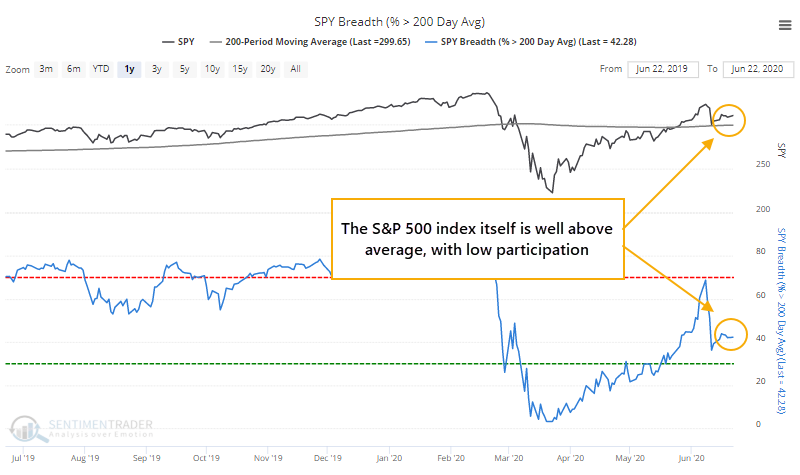
This is a history making year! We have seen the fastest bear market being formed. Then we are seeing the fastest bull market following. Now the market is making another historical event: an internal divergency that has rarely been seen: S&P moved above its 200 DMA over 3% but less than half of the stocks in the index have managed to climb above their own 200 DMA. In other words, this seemingly quite bullish market has quite few stocks coming along with it! What is more, this is a theme across industries, sectors, and world indexes.

S&P above 200-day average with few members

As I said, this is a rare historical event. In the past 30 years, we have only seen once before such kind of dichotomy that happened in the year 2000.  But if we forget about the extreme 3% cutoff but by any amount that S&P was above its 200-day average , and with less than 45% of its members above their averages, then it had happened a couple times more in 2007, and 1999 prior to that. Have you noticed the pattern for this rare event occurrence in terms of timing? Yes, the only three times of the occurrence before were just prior to the historical stock bubble burst. Am I saying we are on the verge of another bubble crash in the same magnitude? Probably not......at least not yet! However, history often rhymes if not repeating it. "What we do know is that periods of rising index prices and high optimism, during markets where relatively few stocks are in long-term uptrends, have a strong tendency to resolve lower in the weeks-to-months ahead."...... a statement from a wiseman that I totally agree with! 

Of course, this does not necessarily mean a huge market crash is imminent but just an early warning sign.  I will share more thoughts in my next blog on this.     

Saturday, June 20, 2020

30-years annualized returns for investors

Has the market lost its mind? Of course, we are always told the market is always right. But something indeed really weird is occurring everyday now: This week, for example, CARV has rallied from $2 to $16, and UONE has gone from $2 to $44. There's no news on either company to account for the moves. The only thing that may explain is that most customers of both firms are African-American. As such, the market FOMOs may be thinking that what is happening now in the US must be great for the companies and therefor chasing them to the moon?!👶😳  

Sure from time to time, some people may get lucky by chasing but in general, this kind of reckless investing and trading will not end well. My friend forwarded me this chart which is very interesting and telling. It is the average annualized return by asset class in the past 30 years. If investors in general is also considered as an asset class, then it is scored at the very bottom, with a return even barely beating inflation I believe.

The message? Choose any asset class you like and put your money there without touching it. You have a higher chance to get a much better return over time!

image

Friday, June 19, 2020

Bull vs Bear case

It is amazing to see the constant fight between bull and bear, which from time to time could be fierce and volatile. I shared an analysis by Lance Robert last week about the view of "overly optimistic", which was consistent with what I had been saying for a while. It turned out to be quite spot on timing wise as the market got a mini crash over 5% early this week. Anyone who was shorting the market late last week should be quite happy for a very nice gain. Then the bull mounted a fierceful fight back. Clearly the battleground for bulls and bears is rather dynamic and unsettling with both cases that can be made. So let me share with you another piece of an analysis by Robert just about that.  I personally find his work is quite thoughtful and insightful. Hope you feel the same!

A quick word about my betting for next week. I think there is a high chance we may see another mini crash for S&P in the range of 50-100 points down. Will see if I'm right about it again!

*************************************************************************************************************************** 

The Bull's Case

The bullish case for the market is pretty thin.

  1. Hopes are high for a full reopening of the economy
  2. A vaccine
  3. A rapid return to economic normalcy.
  4.  2022 earnings will be sufficiently high enough to justify "current" prices. (Let that sink in – that's two years of ZERO price growth.)
  5. The Fed.

The Bear's Case

The bear's built their case on more solid fundamental views.

  1. The potential for a second wave of the virus
  2. A slower than expected economic recovery
  3. A second wave of the virus erodes consumer confidence slowing employment
  4. High unemployment weighs on personal consumption
  5. Debt defaults and bankruptcies rise more sharply than expected.
  6. All of which translates into the sharply reduced earnings and corporate profitability. 

Short-Term Bulls, Longer-Term Bears

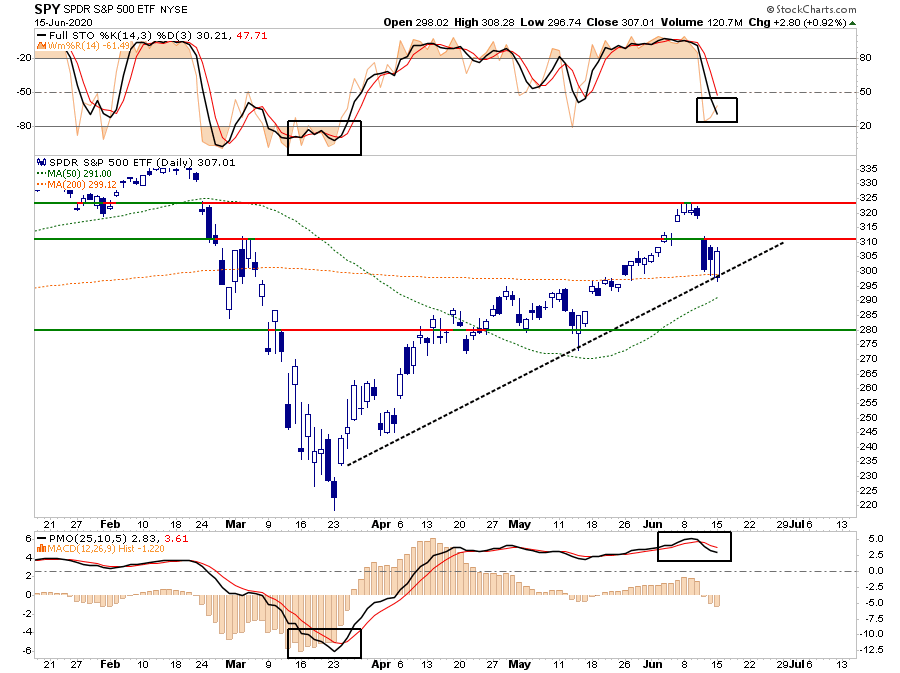
From a purely technical perspective, the bulls remain in control for now. As shown below, the market was able to work off some of the short-term overbought condition without a confirmed break below the 200-dma.  Importantly, the correction also held the uptrend line that has been running since the initial gap-up off the March 23rd low.

bulls bears, Technically Speaking: Bulls & Bears Square Off At The Line

However, the lower MACD and Price Momentum Oscillator are on clear "sell signals," which suggests risk to the bulls in the short-term. With resistance at Thursday's "gap down" open just slightly above Monday's close, the risk/reward for markets very short-term is poor.

If the market breaks the uptrend line, the 50-dma and the May consolidation range lows will be the next lines in the sand.

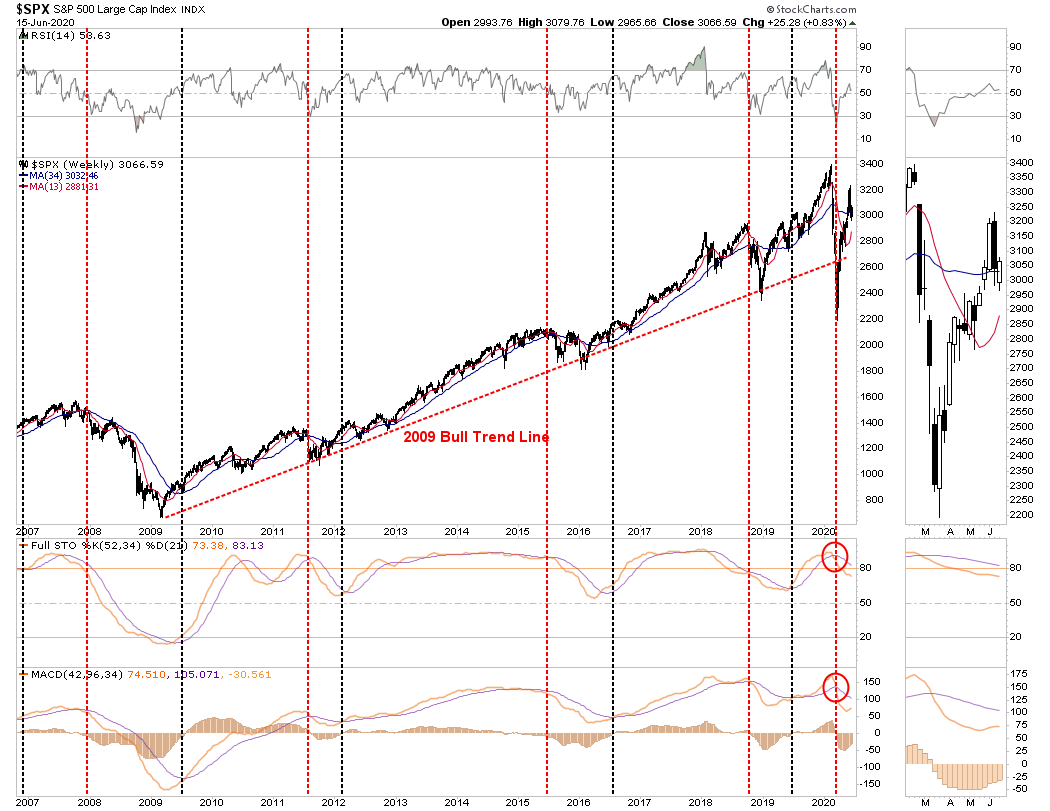
It is worth noting that both of the primary "sell signals" remain intact on a WEEKLY basis. Such suggests we may not be through the "bear market" phase just yet. While such doesn't necessarily mean the market will crash, historically returns have been lower with much higher volatility.

bulls bears, Technically Speaking: Bulls & Bears Square Off At The Line

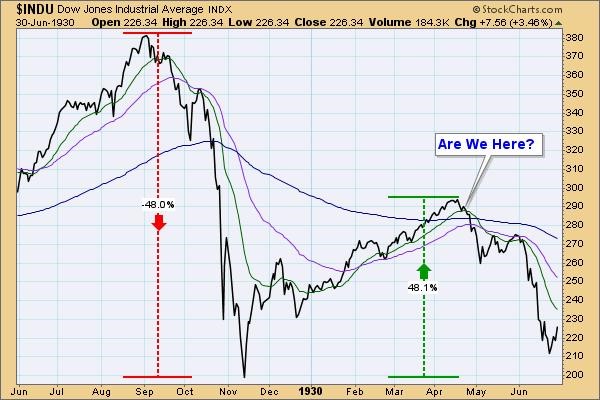
On Wednesday, we pointed out the similarities between this year's price action and the price action during the 1929 crash and the rally that followed. Whether or not we have just seen the top of the rally, I believe there will be a top soon and that it will look like this."

bulls bears, Technically Speaking: Bulls & Bears Square Off At The Line